Development and History of the First World War
I. European politics before the First World War
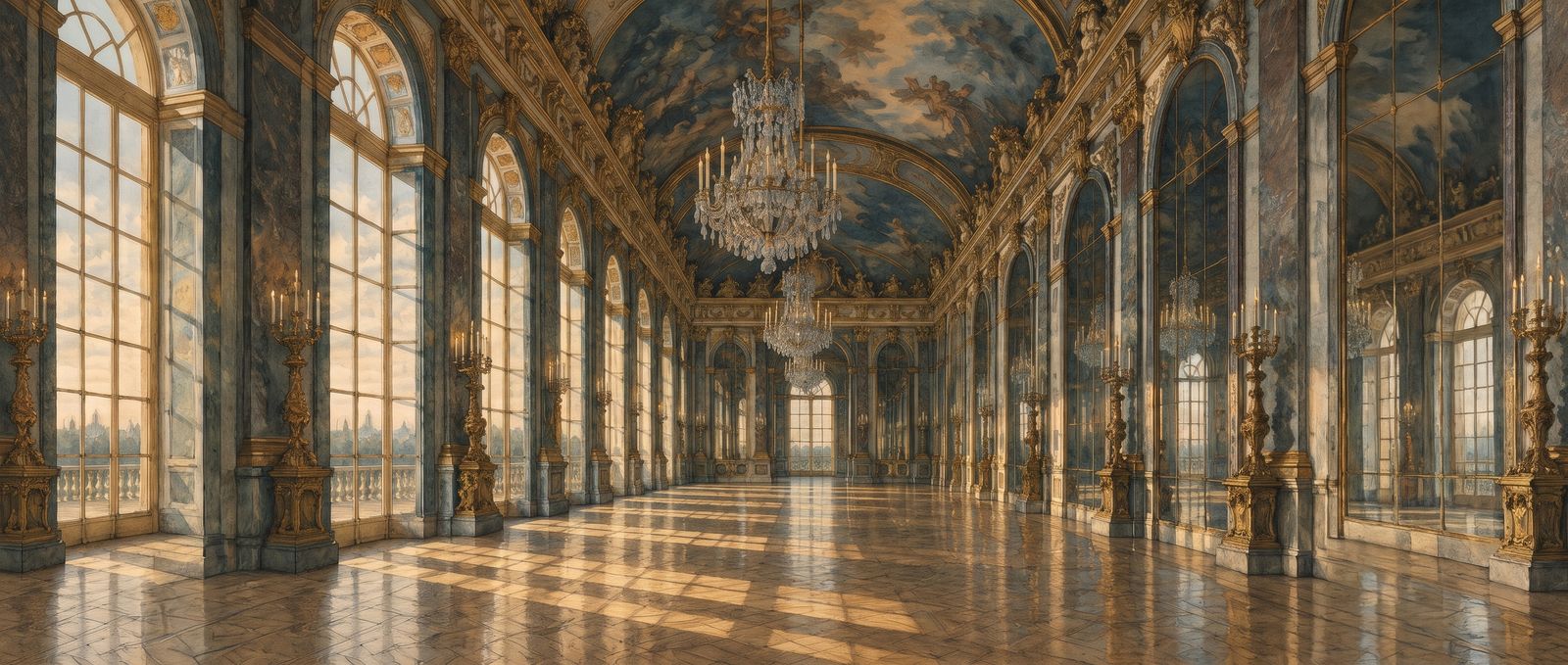
18 January 1871. In the Hall of Mirrors at Versailles, the kings, federal princes, princes, ministers and military men of all the German states have gathered. King Ludwig II of Bavaria, in the name of the German princes, presents to the Prussian king, Wilhelm I, his proclamation as "German Emperor". To the left in front of the podium stands the man who made all this possible through his skilful and often risky politics: Prince Otto von Bismarck, a friend of good food and quick wars. The prestige politics of Napoleon III and the French fear of a Prusso-German hegemony, as well as a diplomatic skirmish between Prussia and France over the possibility of a German prince succeeding to the vacant Spanish throne, led to the French declaration of war on Prussia on 19 July 1870, which Bismarck welcomed.
To the surprise of the French, however, this did not lead to a Franco-Prussian War, but to a Franco-German War, since the south German states took part in the war.
Thanks to the superior planning of the Chief of the Prussian General Staff, Helmuth von Moltke, the Prusso-German deployment and the subsequent offensive take place with great speed. As early as 1 September 1870, the bulk of the French army under MacMahon, with 104,000 men, has to capitulate at Sedan. Napoleon III is taken prisoner.
With this the war against France is practically won, if not yet over. On 4 September 1870 the Third Republic is proclaimed in Paris and a Committee of National Defence is formed, but on 10 May 1871, after preliminary negotiations in Versailles, France has to conclude the Peace of Frankfurt am Main.
France loses Alsace and Lorraine, has to pay 5 billion francs in war indemnities and must accept that parts of eastern France remain occupied by German troops until the reparations have been paid in full. The disgrace of defeat and the terms of the peace treaty left lasting wounds and deep-seated feelings of revenge in France.
With the founding of the German Reich, a federal state under Prussian hegemony, a new great power emerges in Europe alongside France, Great Britain, Russia and Austria-Hungary, further complicating the balance of power in Europe.
Bismarck remained Reich Chancellor until 1890. By that time the age of industrialisation and imperialism, that is, the race of the great powers for colonies, had long since broken out. Throughout this period Bismarck remained the maker of German domestic and foreign policy. His aim was not colonies; above all he wanted to drive forward the industrialisation of Germany and preserve what he had created in 1871. As long as Wilhelm I was emperor, he succeeded quite well in this. Through skilful diplomacy and secret treaties he managed to prevent Germany's isolation and its encirclement by its potential enemies.
Bismarck countered France's expected policy of revenge by trying to isolate France and by promoting the republic and French colonial policy. In 1872 Germany concluded the League of the Three Emperors with Austria-Hungary and Russia "to ward off possible dangers".
In 1875 there is a European crisis because of French rearmament. Russia and Great Britain take steps in Berlin against alleged German intentions of a preventive war. By contrast, there is a rapprochement with Austria-Hungary, which hopes for German support in its Balkan policy. Uprisings by Turkish vassals in the Balkans in 1875/76 escalate into war between Turkey and Serbia. To liberate the Balkan Christians, Russia begins the Russo-Turkish War of 1877-1878.
The Peace of San Stefano in March 1878 brings an enlargement of the Balkan states at the expense of European Turkey. England and Austria protest against the growing Russian influence in the Balkans. Bismarck mediates as an "honest broker" at the "Congress of Berlin" in June/July 1878:
Romania, Serbia and Montenegro become independent; Bulgaria remains an autonomous principality paying tribute to Turkey, but loses Macedonia to Turkey and Eastern Rumelia, which becomes autonomous. Russia receives Bessarabia and parts of Armenia, England receives Cyprus, and Austria receives the right to administer Bosnia and Herzegovina. Despite this settlement, the congress had not been able to solve the problems in the Balkans. It also brought about a German-Russian estrangement and sharpened the antagonism between Austria and Russia in the Balkans.
In 1879 Germany and Austria conclude the Dual Alliance; after Russia comes round in 1881, the League of the Three Emperors is renewed, which promises the allies the neutrality of the others in the event that a further power attacks one of the allies. In 1882 Italy joins the German-Austrian Dual Alliance, creating the Triple Alliance, which Romania also joins in 1883. The Triple Alliance pact promised the neutrality of the others if one of the partners was attacked, and active help from the others if attacked by 2 powers.
In 1887 Bismarck also concludes the "Reinsurance Treaty" with Russia, in which both states promise neutrality in the event that Germany is attacked by France or Russia by Austria.
After the death of Emperor Wilhelm I, Emperor Friedrich III ascended the throne in March 1888, but died as early as June of the same year. Thereupon Prince Wilhelm ascended the German throne as Emperor Wilhelm II. With this, German foreign policy took a decisive turn.
Unlike Bismarck, who was a cautious tactician in foreign affairs and wanted to avoid Germany's isolation, Wilhelm II was impulsive and imbued with imperial ambition. He and Bismarck did not have a particularly good relationship. Mainly because of domestic policy differences between the young emperor and the old chancellor, and the fact that Wilhelm wanted to rule himself, Bismarck was dismissed in March 1890.
Although Bismarck, as already mentioned, acted rather hesitantly on the question of acquiring colonies and trading posts so as not to let Germany come into conflict with the other great powers, the founding of the Colonial Society in 1882 and the Society for German Colonisation in 1884 drove forward the acquisition of overseas territories: at the Congo Conference of the great powers in Berlin in 1884/1885, Bismarck decides "to let the flag follow trade". By 1885 Cameroon, Togo, German East Africa as well as the Marshall Islands, the Bismarck Archipelago, the Marianas and parts of New Guinea and the Solomon Islands become German protectorates; there are also German trading posts in Tsingtao and Kiautschou.
After Bismarck's dismissal, the less independent Leo von Caprivi becomes Reich Chancellor from 1890 to 1894. This allows Wilhelm II to gain greater influence over Reich policy. The maxim "world policy as a task, world power as a goal, the fleet as an instrument" is noisily championed by the "Pan-German League", founded in 1891. Overestimating its own strength, Germany embarks on an aimlessly wavering foreign policy.
First of all, in 1890, contrary to Russian wishes, the "Reinsurance Treaty" is terminated. As a result, a Franco-Russian understanding begins to develop, which in 1894 leads to a Franco-Russian treaty of alliance, the so-called Dual Alliance. At the same time, German-British relations cool because of fierce trade competition and a congratulatory telegram from the German emperor to the president of the Boer Republic of Transvaal in South Africa, because it had resisted a British attempt to eliminate this Boer republic by instigating a revolution.
In the Boer War of 1898-1901 the Boers were in the end subjugated by the British after all. In 1898 there was also a crisis between France and Great Britain, the so-called Fashoda crisis. A British and a French expedition, both with the task of incorporating the Sudan into their own colonial empire, ran into each other near Lake Chad. At first neither France nor Great Britain wanted to give way, but when Great Britain finally threatened warlike measures, the French gave in and withdrew their expedition. Great Britain had prevailed, but the Fashoda crisis and British policy towards the Boers caused anti-British feeling in Europe, so that Great Britain thought it advisable to abandon its isolationist policy and look for allies.
Relations with France and Russia were poor; nevertheless, alliance talks between Germany and Great Britain in 1898 came to nothing.
As part of the German striving for world power and on the initiative of Admiral Freiherr von Tirpitz and national associations, Germany decided in 1898 on a large-scale naval construction programme. The fleet was to be strong enough to protect Germany's overseas interests and to pose a risk to any other fleet. More than any other country, Great Britain depended on its overseas trade. A fleet strong enough to cut Great Britain's overseas connections could starve the island.
The British Parliament agreed that the British fleet must at all times be at least as strong as the next two largest fleets combined. So Great Britain, too, launched a large naval construction programme to enlarge its fleet. As a result, there was a fierce naval arms race between Germany and Great Britain that worsened the political relations between the two countries from year to year.
In the meantime there was a rapprochement between Great Britain and France on colonial questions. In 1904 the French recognised the British claim to Egypt, while the English recognised Morocco as a French sphere of influence. Both nations agreed to enforce this arrangement even against the protest of other nations. This agreement was not a treaty of alliance, since neither country committed itself to providing assistance in the event of war. This agreement between France and Great Britain was given the name "Entente Cordiale", which means something like "cordial understanding".
After the reconciliation with Great Britain, France tried to bring about a rapprochement between Russia and Great Britain.
For a while Russia had turned its attention to its East Asian policy, where it wanted to increase its influence. A conflict of interests with Japan arose over Liaotung with the port of Port Arthur, which finally led to the Russo-Japanese War of 1904. After the Russian defeat in the naval battle of Tsushima and the land battle of Mukden, Russia backed down and turned its attention back to European politics.
After the defeat by Japan, Russia, and in view of the German-British naval arms race England, were ready for a settlement between the two countries.
In 1907 Persia was divided into a British and a Russian sphere of influence, and although England did not accommodate the Russians in their Balkan policy, relations between Russia, France and Great Britain became increasingly friendly, and in 1908 the Triple Entente was formed.
By 1905 the Germans were already alarmed by the Franco-British rapprochement. To test how far British support for France would go, they chose Morocco as the touchstone. In March 1905 a German warship came into the port of Tangier. Kaiser Wilhelm went ashore and made a speech in which he spoke out for the independence of Morocco. This was the occasion of the first Moroccan crisis. The aim of the Germans was to disrupt the Franco-British understanding. They therefore requested a conference of the great powers to settle the Moroccan question. This conference took place in 1906 in Algeciras in Spain. But only Austria-Hungary supported the German position. Instead of disrupting the Entente, the Germans had only made it stronger.
In 1911 the second Moroccan crisis occurred. Contrary to the agreements of Algeciras, the French extended their rule in Morocco. Thereupon Germany sent the gunboat "Panther" to Agadir, supposedly to protect German trade interests. In reality, however, this "gunboat diplomacy" was a threat against France. But the Entente again stood together and France was given a free hand in Morocco,
Slowly the coalitions clearly emerged: on one side the Triple Alliance of Germany, Austria-Hungary and Italy, on the other the Triple Entente of Russia, France and Great Britain.
II. The Balkans as a trouble spot
All this while, the Balkans were in ferment. The various Slavic Balkan peoples sought freedom from Turkish and Austrian rule. In this they were supported by Russia, which saw itself as the protecting power of all Slavs. Although the Ottoman Empire was growing ever weaker, it still ruled in a number of Balkan countries. South of the Turkish-ruled strip lay independent Greece; to the north Bulgaria, which had self-government but still paid tribute to Turkey, as well as independent Romania. Serbia adjoined Bulgaria to the west. Neighbouring Bosnia was disputed. In name it belonged to Turkey, but it had been occupied by Austria-Hungary in 1878. North of Bosnia, the Croats and Slovenes were under Austrian rule. The spokesmen of the Slavic independence movement were the Serbian nationalists.
In 1908 there was an upheaval in Turkey. Turkish reformers, the so-called "Young Turks", forced the Turkish Sultan Abdul Hamid to give up his despotic rule and convene a parliament. The aim of the "Young Turks" was to halt the decline of the Ottoman Empire. A strengthening of the Ottoman Empire, however, was not in the interest of Russia, which sought possession of the Dardanelles in order to gain access to the Mediterranean, nor in the interest of Austria, which wanted to annex Bosnia once and for all.
The two countries therefore proposed a conference of the great powers at which Austria would support the Russian claims and Russia the Austrian claims. But before the conference could meet, Austria had already annexed Bosnia. In the same year Bulgaria achieved full independence, and the island of Crete passed from Turkish to Greek possession. Since France and England did not support the Russian claims in the Balkans, Russia, to its great annoyance, came away empty-handed. The conference was never convened.
The first Balkan crisis passed without war, but left much bitterness.
The Russians were embittered by their failure, Turkey by the loss of Bosnia, and Serbia by Austria's annexation of Bosnia.
The Serbian secret society "Narodna Odbrana", usually called the "Black Hand", begins, with the support of parts of the Serbian military, to carry out attacks on high-ranking personalities of the Austro-Hungarian monarchy.
In 1911 Italy, which lays claim to great-power status, declares war on Turkey and quickly occupies Tripoli and the islands of the Dodecanese. Encouraged by Russia, in March 1912 Serbia, Bulgaria, Greece and Montenegro join together in the 1st Balkan League, whose purpose is likewise to cut themselves a slice of the Turkish cake. In October 1912 this coalition declares war on Turkey. Within a short time the Turks are defeated. In the dispute over the spoils, however, tensions now arise between Serbia and Bulgaria. In June 1913 the Second Balkan War breaks out, in which Bulgaria attacks Serbia. The intervention of Greece, Romania, Montenegro and Turkey in favour of Serbia makes the confusion in the Balkans complete. Meanwhile Romanian-Austrian relations cool, since Austria threatens to intervene in favour of Bulgaria but is held back by Germany. In August 1913 the Peace of Bucharest is concluded: Bulgaria loses Macedonia to Greece and the Dobruja to Romania. Serbia is disappointed, since it had hoped the wars would give it access to the Adriatic, but was hindered in this above all by Austria-Hungary. So the second Balkan crisis, too, had passed without a general European war. The third Balkan crisis, however, was not long in coming. It was to plunge Europe into war.
III. The July Crisis
On 28 June 1914 the Austrian heir to the throne, Archduke Franz Ferdinand, and his wife, Countess Sophie, are visiting the Bosnian city of Sarajevo. The purpose of the visit is to inspect the great manoeuvres of the Austro-Hungarian armed forces planned in Bosnia for July. The Serbs know this too. Through the secret society "Black Hand", calls for murder go out to all Serbs. A young Bosnian Serb, Gavrilo Princip, like other Serbs, decides to act. He has received a pistol from a colonel of the Serbian army. The Serbian government did not give the order for the attack, but many members of the Serbian government and military know about the planned attack.
In the hot sun of 28 June, 4 cars move through the streets of the festively decorated city. From the second car, the Archduke and his wife graciously wave to the crowd from time to time as the vehicles make their way towards the town hall. Then, near the Cumuria bridge, a bomb is thrown which misses the Archduke but injures some people in his entourage. On arriving at the town hall, the Archduke expresses his indignation to the mayor. Afterwards, despite the danger of a second attack, he decides to visit the injured in hospital.
When the cars have to stop briefly to turn round, having taken a wrong turn on the way to the hospital, 2 shots ring out; one hits the Archduke, the other his wife. A short time later both are dead.
When Europe learns of this news, at first nobody believes that this could be the occasion for a European war. But in the generally tense situation, in an atmosphere of mistrust and bound by their respective alliance obligations, the situation in Europe comes to a fateful head. No state is willing to give up its national goals for the sake of preserving peace.
- Austria-Hungary clings to the supranational imperial idea.
- Serbia tries to realise a Greater Serbian empire.
- Russia fears another failure of its Balkan policy and faces the alternative of war or revolution at home.
- Great Britain wavers between neutrality and taking sides.
- France regards its alliance with Russia as a means of pressure against Germany.
- Germany stands by its alliance with Austria-Hungary in order to avoid increasing political isolation. In case a war cannot be avoided, the German General Staff presses for it to break out in 1914, since the conditions for defeating France are still favourable now.
- Neither France nor Germany exerts a moderating influence on the policies of their respective allies, Russia and Austria-Hungary.
And so things take their course…
On 6.7.1914 Germany assures Austria of its unconditional loyalty to the alliance. From 20 to 23.7.1914, the French President Poincaré and Prime Minister Viviani visit St Petersburg and for their part assure Russia of absolute loyalty to the alliance. After their departure, on 23.7.1914 Austria presents Serbia with an ultimatum with a 48-hour deadline: it demands that anti-Austrian activities in Serbia be combated with Austrian participation, and that those guilty of and privy to the assassination be punished. On 25.7 Serbia expresses reservations regarding its sovereign rights and orders a partial mobilisation.
On the same day Austria-Hungary declares the Serbian reply unsatisfactory and for its part orders a partial mobilisation. On 25.7 Russia decides in the Crown Council at Krasnoye Selo to support Serbia. German-English attempts at mediation fail.
On 28.7.1914 Austria-Hungary declares war on Serbia.
On 29.7.1914 Russia carries out a partial mobilisation. One day later, general mobilisation takes place in Russia.
The German Chief of the General Staff, Helmuth von Moltke the Younger, urges his Austrian colleague Franz Conrad von Hötzendorf to order general mobilisation and advises against the attempts at mediation still being made by the German Reich Chancellor, Theodor von Bethmann Hollweg – no cooperation between the German political and military leadership.
On 31.7.1914 Austria carries out general mobilisation.
Germany proclaims a "state of imminent danger of war" and, in an ultimatum with a 12-hour deadline, demands that the Russian mobilisation be stopped. In a further ultimatum to France with an 18-hour deadline, Germany demands from France a declaration of neutrality in the event of a German-Russian war; Russia replies that stopping mobilisation is not possible for technical reasons.
Thereupon, on 1.8.1914, Germany mobilises and declares war on Russia. In its reply, France answers that it "will act in accordance with its interests".
Thereupon, on 2.8, Germany demands the right of passage from the Belgian government, which is refused, and on 3.8.1914 declares war on France. The next day the invasion of Belgium by German troops begins. Thereupon Great Britain, which had mobilised its fleet on 1.8 and on 2.8 had promised France protection of its coast, presents Germany with an ultimatum demanding the withdrawal of German troops from Belgium. When Germany refuses, Great Britain declares war on Germany on 5.8.1914. There follow the declarations of war of Serbia on Germany and of Austria-Hungary on Russia on 6.8, of France on Austria-Hungary on 11.8 and of Great Britain on Austria-Hungary on 12.8.1914.
On 23.8.1914 Japan, which wants to appropriate German colonies, declares war on Germany.
On 3.8, after concluding a treaty with Germany directed against Russia, Turkey declares its armed neutrality. After the shelling of Russian Black Sea ports by 2 German cruisers that had formally passed into Turkish possession, the Russian, British and French declarations of war on Turkey follow in the period from 2 to 5.11.1914.
With this, the European war has begun.
IV. Starting situation, planning and comparison of forces
In the first year of the war, 2 coalitions now face each other in Europe: on one side the so-called Central Powers, consisting of Germany, Austria-Hungary and later Turkey, and on the other the Entente, consisting of Russia, France, Great Britain and its Commonwealth, as well as Serbia and Belgium.
The Entente is thus, at least nominally, vastly superior to the Central Powers from the outset: the states of the Entente have a population of more than 258 million, and that without India or the African colonies. Furthermore, the Allies have a much greater industrial capacity. In addition there is a many times larger area of agricultural land and large deposits of strategic raw materials. Moreover, the Allies have command of the sea from the outset, so that the resources of the rest of the world, and above all of the USA, are also available to them.
By contrast, the states of the Central Powers are populated by only 118 million people. Germany is the only country among the Central Powers with a large industrial potential, which, however, is increasingly hampered by the shortage of raw materials and by the shortage of skilled workers caused by their increasing deployment at the front. A further aggravating factor is that the British fleet begins a blockade from the outset, cutting Germany off from the bulk of its supplies, so that it sees itself more and more threatened by famine.
Both Germany and the Western Allies have a very unstable ally: on the one hand Austria-Hungary, because of its high proportion of Slavic population, part of which openly sympathises with the Russians, and on the other Russia, which is industrially underdeveloped and shaken by internal unrest.
The great potential advantages of the Allies, however, only take effect gradually. The German General Staff had long since considered the possibility of a war on 2 fronts. It was obvious that a long war on 2 fronts absolutely had to be prevented. Such a war therefore had to begin from the outset with an offensive seeking a decision that would bring a quick end on one of the two theatres of war. Russia was out of the question for this because of its vast spaces, its poor infrastructure and the fact that the bulk of the Russian army could not be caught from the outset. Field Marshal Alfred Graf von Schlieffen, Chief of the General Staff from 1891 to 1905, had therefore drawn up the Schlieffen Plan named after him. This plan provided that at the outbreak of war the bulk of the German army should deploy in the West, while only weak covering forces were left in the East. While the left wing of the German western army, with relatively small forces, would remain on the defensive in Alsace and Lorraine, the strong right wing was to march into Belgium, bypassing the French fortresses, invade France from the north, envelop Paris and press the French army against the German left wing and the Swiss border, thus annihilating the French army in a gigantic Cannae. 6 weeks were planned for this. It was assumed that the German forces in the East could hold out for that long, since it was hoped that the Russians would only be able to deploy significant forces after this window of 6 weeks. The French, too, have offensive intentions in the West. Their Plan No. 17 provides for the rapid recovery of Alsace-Lorraine right at the start of the war.
V. The Western Front 1914
At dawn on 4 August the German invasion of Belgium begins. By 7 August German troops succeed in occupying Liège. On 14 August 2 French armies begin an offensive against Lorraine towards the Saar. On 17 August the German wheeling wing has completed its deployment. One day later the British Expeditionary Force (BEF) with 4 infantry divisions (4 I.D.) and 1 cavalry division (1 C.D.) joins the French left wing at Maubeuge. On 18 August the great German offensive through Belgium begins.
On 20 August German troops already march into Brussels, but the bulk of the Belgian army succeeds in withdrawing into the fortress of Antwerp, where several German divisions are thus tied down until early October. In the West, 78 German divisions now face 72 French, 6 Belgian and 5 British divisions.
On 20 August General Joffre, the French commander-in-chief, orders the French 3rd and 4th Armies to break through the German wheeling wing between Thionville and Dinant. This leads to 5 days of fierce frontier battles between German and French troops. Both sides suffer heavy losses. The German wheeling wing is still making good progress, but by now the French have recognised the danger of envelopment and extend their front to the north-west. Because of the fierce French resistance, the widely spread German wheeling wing has to draw together, and thus abandon the intention of enveloping Paris to the west. The German 1st to 3rd Armies of the right wing cross the Marne between 3 and 4 September and push past Paris to the east. In doing so they underestimate the danger of a counter-attack from the direction of Paris. Furthermore, the German advance now begins to flag. The transfer of 2 army corps to the Eastern Front because of a Russian offensive in East Prussia, the ever longer supply lines and the leaving behind of besieging troops before Antwerp and Maubeuge have robbed the German right wing of its numerical superiority. On 6 September strong Allied forces launch a counter-attack frontally and on the flank from the Paris area. Until 12 September, the greatest battle in world history so far rages on the Marne. Because of poor coordination between the German armies, a 40 km wide gap opens on 8 September between the German 1st and 2nd Armies, which is promptly discovered by Allied aerial reconnaissance. 18 Allied divisions thrust into this gap, so that by 13 September the Germans have to withdraw behind the Aisne. With this "Miracle of the Marne", the Schlieffen Plan has finally failed. On 13 and 14 September the Allies make a further attack on the Aisne, but it fails: the Germans have meanwhile dug in.
Because of the German failure, the previous Chief of the General Staff, Helmuth von Moltke, is replaced on 14 September by Erich von Falkenhayn.
Now the "Race to the Sea" begins. Both sides try to envelop each other in the north and thereby push each other towards the North Sea. This race also ends there, since neither side now has any room to manoeuvre. Germans and Allies now dig in, and this is the beginning of a terrible 4-year trench war. The generals on both sides have not yet grasped the enormous defensive strength of an entrenched army equipped with machine guns and quick-firing guns. So both sides try to break through the enemy's line of trenches. From 20 October to 3 November Falkenhayn attacks in Flanders in order to take Calais and Dunkirk. The young German reserve corps suffer devastating losses here. On 10 November Falkenhayn begins an attack on Ypres, but after 8 days he has to call off this attack too after the heaviest losses.
A crisis on the Eastern Front now forces the Germans to transfer several divisions there. So the Germans go over to the defensive in the West. General Joffre now plans to wear the Germans down over the winter through tactical attacks, or to "nibble" at them, as he puts it.. Between 17 and 23 December the Allies attack unsuccessfully at Arras and in Champagne. At the end of December calm returns to the Western Front.
The Eastern Front
On the Eastern Front in 1914 there are two main theatres of war: East Prussia and Galicia. In East Prussia, as early as 17 August, Rennenkampf's Russian Niemen Army from the east and Samsonov's Narew Army from the south are advancing against the weak German 8th Army. After an indecisive battle at Gumbinnen against Rennenkampf, Colonel General von Prittwitz decides to withdraw the German forces behind the Vistula. He is thereupon relieved and replaced by Colonel General von Hindenburg, assisted by Major General Ludendorff as chief of staff.. Thanks to radio intelligence, favoured by Rennenkampf's passivity, the two can take the risk of leaving only 1 division in front of Rennenkampf's army and, with the bulk of their army, inflict a decisive defeat on Samsonov at Tannenberg.
Meanwhile in Galicia the Austro-Hungarian armies and the Russian South-Western Front go over to the offensive almost simultaneously: 48 Austro-Hungarian divisions run into 66 Russian divisions here. The Austrians are heavily defeated and lose over 250,000 dead and wounded as well as over 100,000 prisoners. The Russians lose about 250,000 men.
After the arrival of 2 German army corps from the West, the German 8th Army also attacks Rennenkampf's Niemen Army on 8 September and inflicts a severe defeat on it. After that the Germans have to shift their focus to the south in order to support their wavering Austrian ally. In Silesia the German 9th Army is formed, which on 28 September begins a relief offensive towards Warsaw. Having arrived just outside Warsaw, this turns out to be stirring up a hornet's nest: over 60 Russian divisions are massed in the Warsaw area, now faced by the Central Powers with 23 divisions. By the end of October the units of the Central Powers have to retreat 150 km to the Reich border in nerve-racking rearguard actions. By destroying all communications they manage to halt the Russian advance there. Because of the advance of the Russian centre, a unique, a golden opportunity now presents itself to the Germans: through the Russian advance of the centre, the connection to the forces in front of East Prussia is almost torn, and a German thrust from East Prussia into the rear of the Russian centre is possible. For this, Ober Ost needs about 12 divisions of reinforcements from the West in order to reach an attacking mass of 28 divisions. These forces are available, but are thrown by Falkenhayn into the furnace of the 2nd Battle of Flanders. So this offensive, too, fails for lack of sufficient forces. After that the Eastern Front also freezes into trench warfare.,
The Balkans
Here Austria-Hungary musters 462,000 men against Serbia. On 12 August the Austrian offensive against Serbia begins, but after 8 days it gets stuck without any significant gains. A second offensive on 8 September and a third on 6 November also get stuck after a few days. Belgrade is taken for a short time, but it is lost again through a Serbian counter-offensive. Towards Christmas the fighting here dies down.
Other events
On 26 August the light cruiser Magdeburg runs aground in dense fog off the northern coast of Estonia. The signal books for encrypting radio traffic were not destroyed, and so the Russians found one on the seabed and two more on board. On 13 October one of these books was handed over to the British, who could thereupon read all German naval radio messages thanks to the work of the British Admiralty's decryption service, housed in Room 40, which gave the department the name Room 40, and this was to become a very important strategic and tactical advantage. In 1914 the British came into possession of a German diplomatic cipher code in Persia. The German telegraph cables to the USA were cut by the British at the beginning of the war, and other foreign cables used by the Germans were illegally tapped. The Zimmermann Telegram, recorded on 17 January 1917, which was meant to incite Mexico to war against the USA, could be decrypted and passed on to the USA without exposing Room 40 in the process, and this led to the entry of the USA into the war on 6 April 1917 and thus to the decision of the war.
On 22 September U-9 succeeds in sinking three British cruisers in the North Sea. On 1 November Graf von Spee, who commands the German East Asia Squadron, succeeds in sinking two British cruisers off the coast of Chile at Coronel. On 8 September, however, Graf Spee runs into a superior British force at the Falkland Islands, which sinks 4 of the 5 German cruisers. The 5th cruiser, the "Dresden", is sunk 3 months later at the Juan Fernández Islands. Overall the Royal Navy remains superior to the German High Seas Fleet in a ratio of 3:2.
The role of the airmen is at this time still mainly limited to reconnaissance. However, the first bombs are already being dropped, and the first air battles with rifles, hand grenades and bricks also take place.
At the beginning of the war the Turkish army is in a desolate state and is completely dependent on its allies for ammunition and equipment. The following theatres of war arise for Turkey: the Dardanelles, the Caucasus, Palestine and Mesopotamia. In the Caucasus the Turks suffer heavy losses through a winter offensive they undertake: almost 80,000 men freeze or starve to death. On 7 November a British expeditionary corps lands in Kuwait to secure the vital oil wells.
Most German colonies are lost in the period from 26.8.1914 to 18.2.1916. The only exception is German East Africa, where Paul von Lettow-Vorbeck successfully offers resistance until the end of the war. With only 3,000 Germans and 12,000 askaris he ties down 130,000 Commonwealth troops here.
VI. The Western Front 1915
At the beginning of 1915, in the West, the 1.7 million German troops face about 2.4 million Allied troops. In view of this balance of forces, Falkenhayn plans no offensive seeking a decision for 1915. General Joffre, the French commander-in-chief, wants at least to recapture the lost French territories this year.
So on 16 February he orders the offensive in Champagne to be resumed. After gaining a strip of ground of 2 x 8 km and losing 240,000 men in the entire winter battle, however, he has to call off the offensive.
German losses: 45,000 men. On 10 March a British offensive at Lille likewise fails with heavy losses.
At the council of war in Chantilly on 29 March, Joffre and the British commander French now agree on a joint major offensive in May at Arras. Falkenhayn, who absolutely wants to take Ypres, decides for this purpose to use poison gas on a large scale for the first time. So a German attack at Ypres begins on 22 April with a chlorine gas attack on a 6 km front.
The unprotected Allied troops lose 15,000 men as a result. The Germans achieve a breakthrough, but are themselves surprised by the effect of their new weapon and fail to exploit the favourable situation quickly. So further attacks get stuck after Allied reserves have been brought up. Ypres is not taken. The use of this weapon, which violates international law, leads to an intensification of warfare and new horrors for the soldiers, but to no decision. .
On 9 May 1915 the Allied offensive at Arras begins. The attack is preceded by a 5-day artillery preparation. By 16 June the Allies have managed to conquer a strip of 1.9 x 5.5 km. The price: around 132,000 men. Despite the failures so far, the Allies decide at a new conference in Chantilly on 7 July on a new offensive at Arras and in Champagne.
For this attack the Allies now have 150 divisions with 2.9 million men at their disposal, while the Germans have 100 divisions with 1.9 million men. On the morning of 25 September the Allied offensive begins simultaneously in Artois and in Champagne. The fighting drags on until 1 November, but once again no breakthrough is achieved. The Allies lose 250,000 men, the Germans 150,000 men. After that the fighting largely dies down until Christmas. The Allied offensives fail for several reasons: through the days-long artillery preparation they throw away the element of surprise,, and they also lack heavy high-angle guns. They do not succeed in covering the German defence system in its full depth.
Nevertheless, threatening crises repeatedly occur on the German side, because Falkenhayn does not want to give up 1 m of ground voluntarily. He positions the bulk of the German forces in the 1st line, which thus lies within range of the Allied artillery from the outset and suffers unnecessarily heavy losses as a result. Furthermore, this practice leads to a lack of reserves in depth. So the German defence drags itself from one crisis to the next.
The Eastern Front
In 1915 the main efforts of the Central Powers lie in the eastern theatre of war, since it is hoped that a separate peace with Russia can be reached here. So on 23 January the Central Powers begin an offensive with 20 divisions from the Carpathians towards Przemyśl in order to relieve this besieged fortress. Shortly afterwards, on 8 February, a German offensive begins at the Masurian Lakes, which ends with the destruction of the Russian 10th Army. The Germans take 95,000 prisoners. In the south the Central Powers fail to relieve Przemyśl: 120,000 Austro-Hungarian troops go into captivity.
A further 500,000 men have been killed, wounded or captured in the relief attempt. So in April 1915 about 1.3 million men of the Central Powers face 1.8 million Russians. Nevertheless, on 2 May the Central Powers achieve a successful offensive at Gorlice-Tarnów. The Russians are thrown back 100 km. Through further attacks the Central Powers recapture the fortress of Przemyśl by 3 June and reach the San. Through further offensives Warsaw is taken on 5 August. Russian counter-attacks towards the end of the year fail. The fighting morale of the Russian armed forces has suffered badly from the repeated defeats. In the course of their offensives the Central Powers have taken almost 1 million Russian prisoners. Furthermore, the setbacks lead to internal unrest in Russia.
The Balkans
As early as the beginning of 1915 the Central Powers plan a renewed offensive against Serbia. Because of the tense situation on the Western and Eastern Fronts, however, they can only provide sufficient forces in October. Bulgaria, which was courted intensely by both sides, entered the war on the side of the Central Powers on 14.10.1915. A month earlier, in violation of Greek neutrality, the Allies landed an expeditionary corps, the so-called "Army of the Orient", at Salonika. On 7 October the Central Powers open their long-prepared offensive against Serbia. By the end of November Serbia is defeated and the country occupied. Relief attempts by the Allied Army of the Orient fail.
The Italian Front
Through generous territorial promises to Italy at the expense of Austria-Hungary, the Entente succeeds on 23 May in persuading Italy to enter the war on the side of the Entente. For the time being, however, Italy declares war only on Austria-Hungary. This new front leads to a further aggravation of the situation of the Central Powers. Gradually up to 800,000 of the best Austro-Hungarian troops are tied down here.
The Italian commander-in-chief Cadorna has about 1 million men at his disposal. His efforts are at first directed exclusively at breaking through in the Julian Alps and taking Trieste. For this purpose he carries out 4 major offensives this year on this so-called Isonzo Front. All 4 fail with heavy losses.
The Turkish theatre of war
At the suggestion of the First Lord of the Admiralty, Winston Churchill, the Allies undertake in February 1915 a naval thrust with subsequent amphibious landings at the Dardanelles. The aim is to take the straits and establish a direct connection to Russia for the delivery of war material. By now, however, the Dardanelles have been heavily fortified with German help, and so this offensive ends with heavy losses for the Allied naval and land forces. After tenacious fighting, the Allies decide in December 1915 to evacuate their bridgehead. They have lost 145,000 men, the Turks almost 250,000 men.
The naval war 1915
On 23 January part of the German High Seas Fleet makes a sortie to the Dogger Bank in order to destroy light English reconnaissance forces patrolling there. But since the British have cracked the German naval code, the Germans run into superior British forces there. The Germans lose 1 armoured cruiser; the rest manage to escape. On 4 February Germany declares British waters a war zone. All ships can now be attacked here without warning. This outrages many neutrals. With few exceptions, however, the German U-boats still keep to the prize rules.
7 May 1915. Within sight of the Irish coast, U 20 sights the British luxury liner "Lusitania". At 3.10 p.m. 1 torpedo from U 20 hits the "Lusitania" on the starboard side just behind the bridge. Within 18 minutes the ship sinks. Among the 1257 passengers there are also 218 Americans. As the "Lusitania" sinks, it takes 1198 passengers and crew members, among them 124 Americans, down with it into the depths. This incident outrages American public opinion to the utmost and is one of the triggers for the USA's entry into the war 2 years later. However, the disaster could quite well have been avoided. The torpedo hit was followed by a second powerful explosion, the cause of which has not been clarified to this day, which enlarged the leak; moreover, the ship was smuggling ammunition in secret compartments in violation of international law. The attack was therefore legitimate.
In addition, the position of U 20 was known to the British Admiralty. On its original course the ship would never have come near U 20. Captain Turner, the skipper of the "Lusitania", receives orders to head for Queenstown in Ireland. The British escort ships in this sea area are withdrawn on the instructions of the Admiralty. The release of the safe northern route to Liverpool is kept from Captain Turner. So on 7 May the luxury liner sails directly in front of the tubes of U 20.
Coincidence? It will not be possible to prove it, since the British files on this incident are still kept under lock and key today in the Navy Intelligence Department in Bath. In any case, every dead American was extraordinarily valuable to the Allies.
The air war 1915
In 1915 the air war undergoes a revolutionary innovation: a French pilot, Roland Garros, equips his Morane with a machine gun firing through the propeller arc. To avoid damaging the propeller, he fits steel plates on the propeller to deflect the bullets. In this way he manages to shoot down 6 German aircraft in a few weeks, and for the first time in history one side gains air superiority. The German reconnaissance aircraft are gradually driven from the sky. On 18 April, however, Garros is shot down from the ground. The Morane falls into German hands, and the secret is revealed. Shortly afterwards the German Fokker works succeed in developing a synchronisation mechanism, so that the machine gun only fires when the propeller is not endangered. With this development the Germans seize air superiority again for the second half of the year. Boelcke (40 victories) and Immelmann (17 victories) become the first German flying heroes. At the same time, with German Zeppelin raids on military targets in Paris and London, the age of strategic bombing begins.
VII. The Western Front 1916
For 1916 Falkenhayn wants to shift the German focus back to the West in order to force the decision of the war here. Since the German reserves are not sufficient for a mass breakthrough followed by a war of movement and the annihilation of the Allied army, he develops the "bleeding-white theory". He believes that, through a limited offensive with little use of infantry and strong artillery, he can inflict losses on the French army in a ratio of 3:1. As the scene of this offensive he chooses Verdun. The German army is indeed still superior in heavy artillery, yet the idea of achieving such a bleeding white through constant small attacks, in view of the enormous material and personnel superiority of the Allies, is completely unrealistic. Moreover, the command of the German 5th Army, which is to carry out this attack, is not convinced by the concept of a battle of attrition. So the Supreme Army Command and the 5th Army obstruct each other in carrying out their diverging intentions.
The German offensive begins on 21 February with strong artillery and little infantry. In the following days crises repeatedly occur on the French side, but true to the concept of luring French troops in and wearing them down, the Germans do not force their advance. So the German attacks drag on into June, and because of the prestige that the French attach to the battle, Falkenhayn too feels compelled to throw ever new troops into the "Hell of Verdun", even when his bleeding-white theory has turned out to be a pipe dream. Because of the Allied offensive on the Somme in July, the Brusilov Offensive on the Eastern Front and Romania's entry into the war in August, the German forces are needed elsewhere, and so the German activities at Verdun increasingly subside. Through French counter-attacks in October and November the entire laboriously conquered fortress area is lost again. German losses: approx. 150,000 killed, approx. 187,000 wounded. French losses: approx. 167,000 killed, approx. 210,000 wounded. Furthermore, the German failure leads to Falkenhayn's dismissal on 29 August. He is replaced by Hindenburg and Ludendorff.
With their offensive on the Somme, the Allies now want to break through the German front not in one go, but step by step, each time after a massive artillery preparation. So the offensive begins on 24 June with a 7-day artillery preparation. On 1 July the infantry attack begins. The French gain some ground south of the Somme, but the British have to pay for their gain of a few hundred metres with the highest single-day loss of this war: 20,000 dead, 40,000 wounded. After this fiasco the battle breaks up into numerous attacks and counter-attacks and drags on into November. On 15 September tanks are also used for the first time: 49 British tanks attack the German positions at Flers. 35 of them alone break down through technical defects, yet this deployment produced a great moral effect. It is decided to use tanks on a large scale in the near future. When the Battle of the Somme is ended in November, the Allies have occupied a cratered field 40 km wide and 12 km deep, but have not achieved a breakthrough. The price: 555,000 British casualties, 200,000 French and 500,000 on the German side.
The Eastern Front
On the Eastern Front the Central Powers remain on the defensive throughout 1916. The Russians, on the other hand, whose command has meanwhile been taken over personally by Tsar Nicholas II, strive through large-scale offensives to regain the Polish territory and Galicia. Between 1 and 5 January the Russians attack at Czernowitz. No breakthrough, but a loss of 76,000 men. A further attack at Czernowitz on 19 January also fails: 21,000 men are lost. On 18 March 1916 a great Russian offensive begins in the north of the Eastern Front at Lake Narocz. After 10 days the Russians give up this attempt at a breakthrough: they have lost 140,000 men. After that the Russians halt all major attacks until the middle of the year in order to spare their forces for the great Allied summer offensive and to await Allied relief supplies. So by May the Stavka again has 152 infantry divisions and 47 cavalry divisions with 1.9 million men. The Central Powers can oppose this with 1.1 million men. On 4 June the Russian South-Western Front opens its offensive against the Imperial and Royal armies. Within 3 days the Russians advance up to 30 km on an 80 km front and inflict heavy losses on the Austrian armies. The attacks of the Russian Western Front in the German sector, however, fail. Thereupon the Stavka finally shifts the focus of its offensive to the south and renews its offensive. Meanwhile, however, German reinforcements have been moved into this sector. So further attacks fail, and this operation, known as the Brusilov Offensive, peters out in August. The Austro-Hungarian army has lost 614,000 men; the Russian losses are even heavier.
For the rest of the year there is only local fighting.
The Balkans
At the beginning of the year the Central Powers now occupied Albania as well as Serbia. (Montenegro). The Italian navy succeeds in evacuating parts of the shattered Serbian and Montenegrin troops. The Allied Army of the Orient in Greece at first remains passive. On 20 August 1916 the 460,000-strong Army of the Orient begins attacks against the troops of the Central Powers in Bulgaria and Serbia. There is fighting with changing fortunes, but hardly any gains of ground. Then on 27 August Romania surprisingly declares war on Austria-Hungary and marches into Transylvania. As early as September the 816,000-strong Romanian army has to accept setbacks against the Bulgarians, and after German and Austrian reinforcements have been brought up, the Central Powers begin a vigorous counter-offensive at the end of September.
On 6 December Bucharest falls, and in this campaign the Ploiești oil fields fall into the hands of the Central Powers. This conquest is of decisive importance for the continuation of the war.
The Italian Front
On 11 March General Luigi Cadorna begins the 5th Battle of the Isonzo. On 16 March the attempt at a breakthrough is called off. On 14 May an Austrian offensive begins in South Tyrol. They take Asiago and Arsiero. On 6 August the Italians begin the 6th Battle of the Isonzo. After taking Gorizia the Italians break off the attack. By the end of the year Cadorna attacks on the Isonzo three more times, but he does not achieve a breakthrough.
The naval war
The German Naval Command plans finally to go on the offensive in 1916. Through massive sorties against the British blockade ring, it believes it can inflict heavy losses on the British. On 31 May 1916 the German High Seas Fleet puts to sea with 99 ships, among them 21 modern capital ships. But since the British have broken the German code, Admiral Jellicoe, the commander of the Home Fleet, knows about this plan and plans to lie in wait for the Germans with superior forces. So in the evening the Germans run into 159 British ships, 35 of them capital ships. Through skilful manoeuvring, Admiral Scheer manages to escape an encirclement, and after fierce fighting both fleets lose contact during the night and withdraw. Although the British losses are considerably heavier than the German ones, it seems clear that victory in an open naval battle is not possible. For the rest of the war the German fleet hardly puts to sea any more. This Battle of Jutland (Skagerrak) is the greatest naval battle in history.
VIII. The Western Front 1917
For 1917 the Germans plan to remain on the defensive in the West, since they hope for an early collapse of Russia. In order to meet the major offensive expected for 1917, the German divisions are reduced from 4 to 3 regiments so as to create new operational units. The loss in the divisions' headcount is to be compensated by an increase in firepower.. Through the so-called Hindenburg Programme, German industry succeeds in significantly increasing the output of weapons and ammunition. In addition, on 4 February on the Somme front, the Germans voluntarily withdraw to the so-called "Siegfried Line" (Hindenburg Line), which is much easier to defend. In this way they throw the Allied operational plans for 1917 into confusion. The British and French plan massive attacks for April at Arras, on the Aisne and in Champagne. On 9 April the British attack at Arras. They gain 18 x 6 km of ground, but no breakthrough. Losses: 142,000 British, 85,000 Germans. The French attack on 16 April goes even worse. The new French commander Nivelle, who knows "the secret of victory", believes, on the strength of his victory against completely exhausted German troops at Verdun in November 1916, that he can break through the German positions with ease. Within 2 days the offensive collapses with the heaviest losses. Thereupon, in May 1917, mutinies break out in 54 French divisions. Order can only be restored with difficulty. Nivelle is replaced by Pétain.
After the failure of the spring offensive, the commander of the B.E.F., Sir Douglas Haig, once again believes that the breakthrough can only be achieved through a battle of attrition. From May to October he attacks again and again in Flanders. In the process, mine warfare in the Wytschaete salient reaches a climax on 7 June. With 19 tunnels the British blow the entire 3rd Bavarian Division into the air. In total the British gain 22 x 8 km. British losses: 332,000 men, German losses: 217,000 men. Ammunition expended by the British artillery: 50 million shells. The last major attack of 1917 takes place at Cambrai: 440 tanks and 8 infantry divisions make a surprise attack on the German positions on 20 November and achieve a deep penetration. Insufficient commitment of forces and rapid German countermeasures, however, manage to seal it off. For the rest of the year calm returns to the Western Front.
The Eastern Front
On the Eastern Front the morale of the Russian army has reached a low point in 1917. In 1916 alone 1.5 million men deserted. In view of the unrest among the people, the Tsar is urged by liberal forces to carry out urgently needed reforms. This, however, is categorically rejected by the Tsar. In March 1917 it happens for the first time that a demonstration in Petrograd is not dispersed by soldiers, but the soldiers fraternise with the demonstrators. The Germans want to take advantage of the unrest and smuggle Vladimir Ilyich Lenin from his Swiss exile to Petrograd in order to fan the uprising.
In July 1917 the Russian South-Western Front once again launches an offensive, but it fails. A counter-offensive by the Central Powers throws the Russians far back. Once again there are mass demonstrations. In Petrograd the revolutionary Bolsheviks face the liberal-monarchist forces of the government. For the time being the latter can hold on, and Lenin has to flee to Finland. Successful German offensives in August and September, as well as the occupation of the islands of Dagö and Moon in the Gulf of Riga in October, however, heighten the tensions again. On 7 November Lenin returns to Petrograd to instigate a Bolshevik uprising. It succeeds, the government is overthrown, and the Bolsheviks take power. On 15 December representatives of Russia's new government and of the Central Powers conclude an armistice at Brest-Litovsk.
The Balkans
From February to May there is fierce fighting in Macedonia between the Army of the Orient and units of the Central Powers. This, however, leads to no major shifts of the front. On 1 July Greece enters the war on the side of the Entente. Nevertheless, further attacks by the Army of the Orient in October and November fail.
The Italian Front
On 12 May 1917 General Cadorna gives the order to open the 10th Battle of the Isonzo. It does not, however, lead to a breakthrough. So on 18 August the Italians begin the 11th Battle of the Isonzo. After gaining 6 km they have to give up this attack too. To relieve the Isonzo front, the Central Powers now decide on an offensive of their own. 7 German and 8 Austrian divisions deploy between Flitsch and Tolmein. The offensive begins on 24 October 1917. By mid-November the Italians are thrown back to the Piave. The Central Powers take 260,000 prisoners and capture 3,000 guns. By the end of the year the front stabilises on the Piave.
The naval war
On 1 February 1917 Germany decides, despite the danger of the USA entering the war, to begin unrestricted submarine warfare. It is hoped that this will force Great Britain to its knees within 6 months. This risky step, together with the German attempt, which had become public, to incite Mexico to war against the USA (Zimmermann Telegram), finally leads to the USA's entry into the war on 6 April. At first, however, it actually seems as if the U-boats could strangle England's supplies. By December 1917 the U-boats manage to sink 9,000,000 GRT of merchant ships, and England, by its own account, feels the "knife at its throat". After the introduction of the convoy system, however, the sinkings fall drastically, and the economic potential of the USA makes up for the losses. With this the submarine war has failed.
War and innovation
In the course of the war, science and technology develop rapidly. The Central Powers, affected by the blockade, manage to bridge the shortage of raw materials by developing numerous substitute materials. Both sides develop ever more dangerous war gases. London is by now no longer bombed by Zeppelins, but by four-engined bombers carrying up to 2 tonnes of bombs. The fighter aircraft are mostly robust biplanes that reach 200 km/h or more and are armed with 2 synchronised machine guns. Air battles with a hundred aircraft or more are no longer a rarity. The Allies constantly develop improved tanks and turn them out in masses. The Germans meanwhile also build tanks, but their overstretched industry can only produce small numbers. The lack of tanks and of effective anti-tank defence will prove fatal on the Western Front in 1918.
The Western Front 1918
With the collapse of Russia, the Germans find themselves able to concentrate 200 divisions in the West. Of these, about 70 are suitable for offensive operations. The Germans want to defeat the British and French before the Americans can intervene effectively.
The Germans see this operation, planned for March, as their last chance to win the war. Realistically speaking, however, a complete military victory can no longer be achieved in view of the Allied superiority. A successful offensive, combined with a political defensive, that is, the renunciation of the all too ambitious war aims, might perhaps have made peace negotiations possible on the basis of the status quo of 1914. This, however, does not happen. So the German troops advance into their last battle.
The starting point for the offensive is well chosen. At the Franco-British junction near La Fère, the Allied front is incomprehensibly particularly weak. Exploiting this breakthrough operationally here could lead to the separation of the British and French and to the encirclement of the British with their backs to the sea. Thanks to new tactical principles, the German offensive gets off to a good start on 21 March. By 5 April, however, the offensive flags because of the bringing up of Allied reserves and a mistaken shift of the focus. In addition, the Royal Air Force succeeds in gaining air superiority. The Germans have advanced up to 65 km on an 80 km front, but they do not reach the coast. German losses: 250,000 men. British losses: 240,000 men.
But Ludendorff does not want to admit the failure of the spring offensive. Until June he attacks again and again, in Flanders, at Soissons and on the Chemin des Dames. Each time the breakthrough succeeds, and each time the German strength flags in view of the bringing up of Allied reserves and the exhaustion of the attacking troops. So by June 1918 the German offensive power is finally exhausted, while the Allies can easily make up their losses: month after month, 250,000 men of fresh, rested American troops now land in France. On 18 July the French begin a counter-attack at Villers-Cotterêts with 26 divisions, 400 tanks and 1,100 aircraft. The Germans have to withdraw behind the Aisne. On 8 August the Allies attack between Albert and Montdidier with 32 divisions, 3,000 guns, 430 tanks and 1,900 aircraft. 16 German divisions are wiped out, 53,000 men go into captivity. General Ludendorff calls this "the black day" of the German army. On 4 September the German troops are back in their starting positions. Now the Americans at Verdun and the British in Flanders also attack with far superior forces. Nevertheless General Foch, who has meanwhile been appointed Allied commander-in-chief, does not succeed in annihilating the Germans. By early November they have to withdraw to the Antwerp-Meuse position, but they manage to maintain cohesion. As early as September, however, the OHL has to admit that the war can no longer be won. So on 11 November the armistice finally comes. On the Western Front the guns fall silent.
The Eastern Front
At Brest-Litovsk the representatives of the Central Powers and the Bolsheviks negotiate peace. The Russian delegation, however, is not willing to meet Germany's territorial demands. So on 18 February the fighting flares up again. The Germans occupy Kiev, Livonia and Estonia. So on 3 March the Russians do sign the peace treaty after all. Meanwhile Russia sinks into civil war between Red Guards and Tsarist White Guards. This war will last for years. The Tsar and his family, who have been arrested by the Bolsheviks, are murdered on 16 July 1918. With the armistice in the West, the Central Powers have to withdraw from Russia.
The Balkans
Because of the German attempt to force the decision in the West, the Balkans have been almost completely stripped of German troops. The exhausted Bulgarians and Austrians can no longer withstand the Allied troops. A major offensive by the Army of the Orient and other troops in September leads to a retreat as far as the Danube. Turkey, now isolated, concludes an armistice on 30 October. Austria gives up on 2 November.
The Italian Front
On 15 June the Austrians undertake one more offensive on the Piave front. Bad weather, however, forces the operation to be broken off. On 23 October the Italians launch an offensive, but get stuck. Yet the Austro-Hungarian troops receive orders to withdraw to the national border. So the front runs again as in the previous years.
The naval war
Improved defensive measures make life hard for the U-boats. An order to the High Seas Fleet in October to put to sea for an attack on the Home Fleet leads to the sailors' mutiny in Kiel.
Balance
After 4 years of war, hardly anyone can grasp that there is now supposed to be peace. The losses and costs of the war are immense. Germany had to mourn 2,037,000 dead soldiers, Russia 1,700,000, France 1,385,000, Austria-Hungary 1,200,000, Great Britain 947,000, Italy 460,000, Serbia 360,000, Turkey 325,000, Romania 250,000, the USA 115,000. In total about 10,000,000 soldiers died, and over 20,000,000 were wounded. Over 6 million civilians also perish. The war costs of all countries amounted to about 956 billion gold marks. Three great monarchies have collapsed. Germany and Russia are shaken by severe internal unrest. The victors negotiate the peace terms at Versailles without the participation of the defeated. Little of the moderate ideas of US President Wilson can be felt in them.
Austria-Hungary falls apart into its individual parts.
Germany has to accept sole guilt for the war.
Germany alone is to bear the war costs of all countries.
Germany loses all its colonies.
The Rhineland is demilitarised.
Alsace-Lorraine goes back to France.
East Prussia is separated from the Reich by the Danzig Corridor.
Germany may keep only an army of 100,000 men, without tanks and heavy artillery.
The navy is limited to 15,000 men and ships of up to 10,000 GRT.
When the French Marshal Foch sees these terms, he says: "This is not peace. It is an armistice for 20 years…"