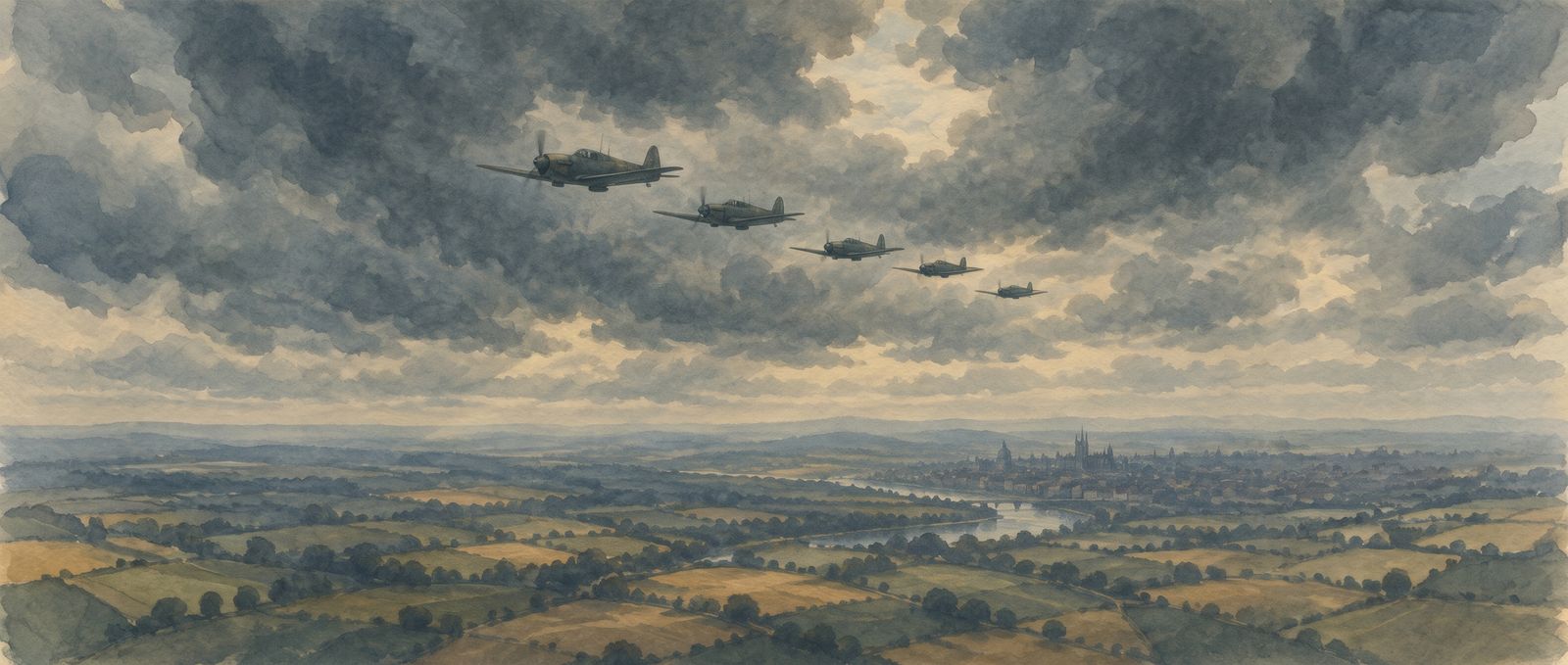
The Air War 1939 to 1945
The dream of flying is almost as old as mankind itself. Greek mythology already knows the legend of Icarus, who, in order to escape from the island of Crete, glued wings to himself with wax, but on his flight came too close to the sun, which melted the wax and sent Icarus plunging into the sea.
In the Middle Ages, the Italian universal genius Leonardo da Vinci studied the flight of birds and designed an apparatus that was supposed to make flying possible.
The glory of being the first people to fly, however, was to be reserved for the Montgolfier brothers, who rose into the air in a hot-air balloon in July 1783.
It was not long before the new invention had to serve military purposes. As early as the wars that followed the French Revolution, balloons tethered to the ground by ropes were used to observe the enemy.
During the Franco-Prussian War of 1870/71, the French used balloons to fly people in and out over the German siege ring around Paris, against which the Germans deployed "Baks": 88 mm balloon defence guns, the beginnings of modern anti-aircraft artillery.
On the beach of Kitty Hawk, North Carolina, modern aviation was born in 1903: Orville and Wilbur Wright achieved the first powered flight in human history, covering a distance of about 300 m.
Again it was not to be long before the new achievement was put to use in the craft of war. Even before the First World War, aircraft were used in smaller wars to observe the enemy.
In the First World War, the aeroplane, at first still regarded with mistrust by the generals, was finally to become a weapon of enormous importance, even if it did not yet have the devastating destructive power of later times.
In the battle that the French call the "Miracle of the Marne", an Allied reconnaissance aircraft discovers the gap between the German wing armies, into which the Allied counter-attack is aimed.
The enemy pilots, who at first still met each other in the air with sportsmanship, soon became aware that the other's information endangered their comrades on the ground. So the first attempts began to bring down the other's aircraft. For this purpose carbines, hand grenades and even bricks were used!
The most effective weapon for this purpose was of course the machine gun; the only problem was that the best firing position was behind the enemy aircraft, and in most aircraft one's own propeller was between the weapon and the enemy.
In 1915 the Frenchman Roland Garros found a simple, not to say rustic, solution to this problem: he attached steel plates to his propeller to deflect the bullets and had the machine gun fire through the propeller arc. With this he struck fear and terror into the Germans.
Soon afterwards, however, he had to land behind the German lines because of engine failure, and the secret was out. The Germans showed the system to the Dutch aircraft designer Anthony Fokker, who was in German pay. Instead of copying it, Fokker and his German engineers devised a far better system: a synchronisation mechanism that only allowed the machine gun to fire when the propeller was not at risk. With this system, Immelmann and Boelcke became the first German flying aces.
This system was soon copied by the Allies, and technology and specialisation in the air war advanced rapidly.
The further the war progressed, the more clearly the tasks were divided: there were reconnaissance aircraft that took aerial photographs of the enemy positions, and also artillery spotters that monitored the fire of their own batteries, even if this task was mostly carried out by tethered balloons.
Furthermore, there were the bombers, which were used in both a tactical and a strategic role. There were the first attacks on cities, in which military targets were usually specified, but the collateral damage was knowingly accepted. While London was at first still bombed by Zeppelins, by the end of the war it was four-engined bombers with a payload of 2 t.
Last but not least, there were the fighters, which fought for air superiority in the sky. These were mainly robust biplanes with 2 synchronised machine guns that reached 200 km/h or more. Men like von Richthofen (80 kills), Udet (62 kills), Löwenhardt (54 kills) on the German side or Bishop, Collishaw, Guynemer or Rickenbacker on the Allied side became popular flying aces.
On 11 November 1918, Germany, which no longer had any hope of victory, concluded an armistice with the Allies. In Versailles, the Allies negotiated a peace treaty without the participation of the defeated and forced the Germans to ratify it. The terms of the treaty sowed the seed for a war of revenge:
Recognition of Germany's sole guilt for the war.
Payment of the war costs of all countries by Germany alone.
Loss of Alsace-Lorraine, North Schleswig, parts of Posen, separation of East Prussia from the Reich, demilitarisation of the Rhineland, Allied bridgeheads on the right bank of the Rhine, loss of all colonies.
Limitation of the German army to 100,000 men and the navy to 15,000 men, surrender of the High Seas Fleet, prohibition of military aviation.
War, which until then had been regarded as "an act of human intercourse", was castigated as a crime.
The humiliation and hardship of the German people and the widespread brutalisation caused by the war were the breeding ground for radical parties of every colour, which fought for power to the left and right of the moderate parties of the Weimar Republic.
After the war, theorists in all countries reflected on what a future war would look like, among them the Italian general Giulio Douhet in his book "Il domino dell´ aria". In it he set down the doctrine that in a future war the enemy could be defeated by massive bombing raids on the enemy hinterland alone.
After Hitler's seizure of power in 1933 and the beginning of Germany's rearmament, General Walther Wever, the first Chief of the General Staff of the Luftwaffe, is an ardent champion of this theory and an advocate of building up a strategic bomber force. In 1936 Wever is killed in a plane crash, and under the dominance of former army officers, Germany builds up a tactical air force specialised in supporting ground troops.
This Luftwaffe is tested for the first time in the Spanish Civil War in 1936. In support of Franco's Nationalists against the communist Republicans, Germany sends materiel and "volunteers" in the Condor Legion. The Condor Legion's air raid on the Spanish town of Guernica gains sad notoriety.
Pablo Picasso captured the horrors of this air raid in a famous painting of the same name; for many it was the first terror raid in history.
Hitler does not expect a general war before 1943. So the ultimatum and the subsequent declaration of war by France and Great Britain after Hitler's invasion of Poland cause considerable dismay in the Reich Chancellery. But the Western powers behave defensively, and the Wehrmacht is able to defeat Poland in its first Blitzkrieg campaign. During the fighting for Warsaw, the capital is attacked and badly damaged by the Luftwaffe, but the targets of these attacks were troops in the capital. The Allies take this attack, together with later German attacks, as a precedent.
In the West, both sides hold back from air raids for fear of the other's retaliation. The Royal Air Force confines itself to attacks on warships in the German Bight. One such attack takes place on 18.12.1939. 22 twin-engined Wellington bombers search for warships over the German Bight but cannot find any. A German Freya radar set on Wangerooge locates the aircraft and alerts a fighter base in Jever. On the return flight, the bombers are caught by 32 Bf 109s and 16 Bf 110s, which are guided to them by a ground control station. In British Bomber Command, the opinion is that the concentrated fire of a closely flying bomber formation is able to repel any attack by fighters. This theory was now to be put to the test.
12 bombers are shot down, 3 badly damaged. The RAF drew the lesson from this that daylight attacks without fighter protection inevitably had to lead to high losses, and the RAF now specialised in night attacks, which with their protective cloak of darkness hid the bomber from the eyes of the defence, but also hid the target from the eyes of the bomber crew. A hard technological contest developed between Germany and Great Britain in the following years over the solution to these two problems.
On 10 May 1940, the start of the German Western offensive, 3 German He 111 bombers accidentally bomb Freiburg. Nazi propaganda thereupon accuses the Allies of bombing open cities and takes this incident as a precedent.
At the start of the Western offensive, German airborne troops landed in Rotterdam, but are encircled by the Dutch and find themselves in a threatening situation. On 14 May German ground troops reach Rotterdam but cannot break through to the encircled airborne troops. Colonel Scharoo, the Dutch city commandant, is called upon by Lieutenant-Colonel von Choltitz to surrender, but refuses. Thereupon an air raid on the part of Rotterdam held by Dutch troops is requested.
At 1.25 p.m., KG 54 takes off in 2 formations, 43 and 57 aircraft strong. They are to bomb Rotterdam unless red flares indicate Rotterdam's surrender. During the approach Rotterdam surrenders, but radio messages to that effect do not reach the bombers, as they have retracted their trailing aerials. The red flares are seen by only one of the two formations; for the others they are obscured by the smoke of the burning steamer "Stratendam".
43 aircraft turn away, but 57 drop 97 t of high-explosive bombs. The very first bombs destroy the main water pipe, others hit a margarine factory, and streams of burning oil flow through Rotterdam and set the old town on fire. 900 people fall victim to the raid; Allied propaganda speaks of 40,000 dead.
This event means a further escalation of the air war: under the impression of the tragedy of Rotterdam, Winston Churchill lifts the ban on bombing German cities.
On 22 June 1940 the Western campaign ends with the capitulation of France. Hitler hopes for an understanding with England, but Churchill wants to fight to the bitter end. So the Wehrmacht prepares Operation Sea Lion: the invasion of England.
The indispensable precondition for this is air supremacy over the Channel and southern England, since the Kriegsmarine is quantitatively no match for the Royal Navy, and the invasion fleet has to be protected from the air. For the first time in the history of war, the decision between victory and defeat depends on the outcome of an air battle.
Now it takes its revenge that the Luftwaffe is geared exclusively to tactical tasks, because it is not suited to this task: the only aircraft that can take on the Spitfire and Hurricane, the Bf 109, can stay over southern England for a maximum of 20 minutes, too little for effective escort. The Bf 110 is too cumbersome. The bombers are too lightly armed and the bomb load is insufficient.
In addition, the British fighter defence is excellently organised: along the British coast stand Range and Direction Finding Stations, later called Radio Detection and Ranging, RADAR for short. The German formations are located while assembling and approaching and are intercepted by fighters guided from the ground.
Furthermore, the British have at their disposal one of the greatest secrets of the last war: ULTRA.
The German codes of the army, the Luftwaffe, the navy, the SS, the SD, the police, the secret services, the Reichspost, the Reichsbahn and the diplomatic corps are encrypted by a cipher machine called ENIGMA. This is a further development of a cipher machine from the civilian economy. By pure chance, in 1928 an ENIGMA in a crate reaches Polish customs, which informs the Polish military, whereupon 2 cryptologists are able to take a look at the find; afterwards the ENIGMA is sent back on its postal route. Civilian ENIGMAs were procured by the Poles. Three years later the Poles receive information from the French secret service about the ENIGMA used by the Wehrmacht and are able to build replicas of it. One man working on decoding the ENIGMA code was a Polish mathematician, Marian Rejewski, who succeeded in breaking into the ENIGMA even before the war, at the beginning of 1933, and at a secret meeting on 26 and 27.07.1939 shared his knowledge with French and British code-breakers. From January 1940 the British are able to read many German radio messages, except those of the German navy. The navy initially used the ENIGMA M3 with an ingenious message key procedure, which was a hard nut to crack at first, and after 1 February 1942 the M3 ENIGMA was replaced by the M4 ENIGMA, which likewise caused a longer blackout for the codebreakers, "the second happy time of the U-boats."
At Bletchley Park, north-west of London, cryptologists and mathematicians, supported by computing machines, have been intercepting and decrypting large parts of German radio traffic since January 1940. At times the British are informed about orders for German units sooner than the German units have decrypted them themselves. This runs under the cover name ULTRA.
The Battle of Britain can be divided into several phases:
From 10 July to 13 August 1940, the Luftwaffe attacks Channel convoys and radar stations. On Göring's orders, however, the attacks on the radar stations are stopped, because the British succeed, by means of emergency transmitters, in fooling the German listening service into believing that destroyed stations are active.
From 13 August to 24 August, various targets such as bases of Fighter Command, Bomber Command and Coastal Command, factories and ports were attacked. After heavy fighting, a period of bad weather causes the fighting to die down.
From 24 August to 7 September, the German attacks concentrate on Fighter Command installations, and the Germans are very close to the goal of air superiority over southern England.
„Then, once again, as at Dunkirk, Hitler came to our aid”, as a British history notes. Attacks on London had been forbidden by Hitler.
A German bomber that tried to bomb oil tanks at Thameshaven on the night of 24 to 25.08 lost its way and bombed London.
Thereupon Churchill orders a retaliatory raid on Berlin: on the night of 25.08 to 26.08, Berlin is attacked by 81 bombers. Further raids follow. After a speech in the Sportpalast in which Hitler threatens retaliation, he orders the attack on London on 4 September.
This takes the pressure off Fighter Command at a critical stage, and the Germans attack a target at the limit of the range of their escort. On 7 September the first major daylight raid on London takes place with 300 bombers and 600 fighters. The attacks culminate on 15 September in an air battle that the British still celebrate today as Battle of Britain Day.
In 2 major attacks, the British claim to have shot down 175 German aircraft. The Germans lose 56, the British 26 aircraft.
The approaching autumn storms and the failure of the Luftwaffe forced the invasion to be abandoned, and Hitler was already planning Operation Barbarossa: the attack on the Soviet Union. The air raids on England, however, continued until May 1941, mostly by night. The target was Britain's industrial potential. The most devastating raid was directed on the night of 14 to 15 November against a centre of the British aero-engine industry: Coventry.
On 14 November 1940 at 3 p.m., Bletchley Park decrypts a German radio message saying that the Luftwaffe is preparing a major raid on Coventry. Wing Commander Winter-Botham, the head of the Ultra project, has Churchill asked whether the civilian population of Coventry should be evacuated.
The Prime Minister refuses, as he fears that this would reveal to the Germans that the British can read their radio traffic.
The secret of Ultra must be kept. (The current state of historical research doubts that the British were as well informed about the planned raid on Coventry as Winter-Botham's account claims. But as a fictitious case study it is simply too good. How would you have decided as Prime Minister, had it been so? That is why it is mentioned here.) In its radio traffic, the Luftwaffe specified code names for the target of the attack. Birmingham was "Bild". Liverpool was "Liebe". The target for this raid, code name "Moonlight Sonata", was "Korn". Since there is no major city in Great Britain beginning with "Ko", the British were at first faced with a puzzle. Only through the raid did it become clear that "Korn" stood for Coventry.
The conditions for the attack are favourable: calm winds and a full moon make navigation easier; the pathfinder unit Kampfgruppe 100, which steers towards the target with X-Geräte using the Knickebein method, ensures precise target marking of the city centre; and since Coventry is only about 400 km from the German bomber bases, many of the 449 German bombers can be used twice.
In the Knickebein method, the bombers fly along a radio guidance beam; when they cross a second radio guidance beam, the pilot hears an acoustic signal telling him that he is over the target.
503 tonnes of high-explosive bombs and 881 incendiary containers fall on Coventry. The fires can only be brought under control the following night. 554 inhabitants of Coventry are killed, 865 are injured.
For the foreseeable future, Royal Air Force Bomber Command was the only weapon with which Churchill could strike Germany. As long as Germany was allied with Stalin, the Royal Navy's naval blockade had no critical effect, and an invasion of the Continent against the combined might of the Wehrmacht was hopeless.
So until the end of 1941 Bomber Command flew raids against Germany which, although they did no serious damage to the German armaments industry, badly damaged Hermann Göring's reputation. So he ordered Colonel Kammhuber to organise a defence system against the British night incursions. Kammhuber then organised the Kammhuber Line with its Himmelbett stations.
The Kammhuber Line stretched in a crescent along the German border. The line consisted of Himmelbett boxes. In such a box, 3 radar sets were installed on the ground: 1 Freya early-warning set, 1 more precise Würzburg set to track the incoming bomber and 1 Würzburg set to guide the night fighter from the ground to the bomber. A well-practised Himmelbett organisation could engage up to 6 bombers per hour.
By the end of 1941, the German night fighters had been credited with 250 aerial victories. In addition, the RAF had to accept losses from flak and accidents.
The moderate success of the RAF until 1942 was mainly due to navigation problems. The course to be taken was generally left to the bomber crews. For navigation, the crews were dependent on dead reckoning. Radio bearings could be used up to a distance of 320 kilometres, but once they had to rely on dead reckoning after that, the average error was 12 km sideways per 100 km of flight path. Moreover, the bombers did not fly in as a massive formation, but as individual aircraft scattered in space and time.
Under these conditions they managed at best to drop 1/3 of the bomb load carried within a radius of 9 km of the target. But with the progress of technology and the declaration of war on the USA after the Japanese attack on Pearl Harbour on 7 December 1941, the air war for German cities was to intensify considerably in 1942.
In 1942 the RAF made massive efforts to increase the striking power of its bombers. The radio navigation aid "Gee" was introduced, with which one's own position could be determined to within 10 km at a distance of 650 kilometres. New bombers were introduced, such as the four-engined Avro Lancaster. This aircraft could haul 3.6 t of bombs as far as Berlin at a speed of 335 km/h at an altitude of 6,000 m. Another nemesis of German air defence was to be the twin-engined de Havilland Mosquito. This fast aircraft served above all for reconnaissance, target marking and as a night fighter.
Furthermore, the RAF now saw through the German interception tactics of the Himmelbett system. Until then, the Kammhuber Line had been crossed at various points spread over hours, and the system was designed for precisely this scale. Now they switched to letting the bombers break through the German defences at a single point in a massive bomber stream.
In addition, in February 1942 Air Marshal Harris took command of Bomber Command; he had the ambition of forcing Hitler's Third Reich to its knees with his weapon alone. For him, not only factories but also the workers and their homes were military targets. The morale of the German population was to be broken.
The navigation aid "Gee" was available from March, and with it large coastal targets, that is, cities, could be hit massively on moonlit nights. In March 1942, 234 bombers reduced parts of Lübeck to rubble and ashes. The following month Rostock was badly hit.
For political reasons and because of a dispute over resources with the other branches of the armed forces, however, Harris had to land an even more spectacular blow: Operation Millennium, the first 1,000-bomber raid. Target: Cologne, still within the range of "Gee". For this operation Harris withdraws 500 aircraft from the flying schools in addition to all available units. At a loss of 41 aircraft, 1,046 bombers inflict heavy damage on Cologne on the night of 30 May 1942. Essen and Bremen are attacked in June with 956 and 1,006 bombers.
From August, however, "Gee" can hardly be used any more; the Germans are now using the jammer "Heinrich" on a massive scale. In addition, early-warning sets are installed on the coast with which the bombers can be located while they are still assembling over England.
To increase precision, the British now use new devices. "Oboe" stations, which guided so-called pathfinders to mark the target with radio beams, accurate to within 350 metres. In addition, the H2S airborne radar was used, which showed the aircraft prominent terrain features beneath it.
The search for the sensitive points of the German armaments industry led on 16 May 1943 to one of the most spectacular raids of the war: the attack on the dams of the Sauerland to cut off the water supply of the Ruhr industry. The Möhne and Eder dams are destroyed, the Sorpe dam damaged.
From 24 July to 2 August 1943, Hamburg is attacked. Through the use of "Window", aluminium strips to blind the enemy radar, the German defence is paralysed. On 27 July the meteorological conditions are favourable for Bomber Command. The initial attempts to flatten German cities with high-explosive bombs have been abandoned. Instead, they now rely on an agent of destruction that multiplies itself: fire.
The pathfinders mark the target with red and green flare bombs. Bombers of the vanguard use heavy bombs that detonate in the air to strip off roofs and push in doors and windows to create a draught. Countless incendiary bombs start countless small fires, which merge into larger fires. Fragmentation bombs with time fuses hinder the firefighters.
Burning houses heat the air above them; it rises, cold air flows in below and fans the blaze further. A firestorm develops.
Wind speed in the streets: up to 240 km/h. Temperature: up to 1,000 degrees Celsius.
Those who stay in the air-raid shelters suffocate. Those who try to flee from the areas hit by the firestorm stick in the road surface or are sucked into the fire. More than 40,000 people of Hamburg die that night.
In contrast to the British tactic of declaring entire cities to be targets and wiping them out by night, the Americans believe that with their heavily armed four-engined bombers, without fighter protection, they can wipe out industrial targets by day with precise carpet bombing.
Regensburg and Schweinfurt, with the Messerschmitt works and the ball-bearing industry, are attacked several times and badly hit. But when, on one such mission, 60 of 363 B-17s are shot down and over 100 damaged, such losses are unacceptable even for the Americans.
From now on they largely confine themselves to missions on which the P-47 Thunderbolt and the P-38 Lightning can still provide escort. With the introduction of the P-51 Mustang, which can escort the bombers as far as Berlin, the tide turns against the overstretched German day fighter force. Under the strain on all fronts against crushing superiority, it is slowly ground down. Day and night fighters can inflict losses on the enemy, but cannot prevent the homeland beneath them from slowly sinking into rubble and ashes.
In 1940, 10,000 t of bombs fall on Germany.
In 1941, 30,000 t of bombs fall on Germany.
In 1942, 40,000 t of bombs fall on Germany.
In 1943, 120,000 t of bombs fall on Germany.
In 1944, 650,000 t of bombs fall on Germany.
In 1945, 500,000 t of bombs fall on Germany, in about 4 months.
For comparison: during the war, 74,172 t of bombs and V-weapons come down on England.
Ironically, the output of the German armaments industry reaches its peak in August 1944 despite the massive attacks.
For example, 4,800 fighter aircraft are produced in that month alone.
This is achieved through ruthless exploitation of the workforce and through the decentralisation and relocation of industry, for example into underground factories in the Harz mountains.
All the war materiel produced, however, is fairly useless, since in the end the Allies have found the Achilles heel of German armaments after all: the oil supply. Through the destruction of refineries and hydrogenation plants, the Wehrmacht is immobilised.
The question is no longer whether Germany will lose the war, but how much longer the Nazi leadership can delay defeat. Slogans urging people to hold out, coercive measures and belief in the promised miracle weapons are meant to keep the people in line. In the later phase of the war, the destruction of the enemy's civilisation is already less tied to military benefit than an end in itself. It is against this background that the destruction of Dresden must be seen.
In February 1945, Montgomery's 21st Army Group is preparing to cross the Rhine at Wesel. The Soviets are close to the Oder. Churchill urges Roosevelt to occupy as much of Germany as possible before the Russians. The alliance with Stalin, or Uncle Joe, as Roosevelt calls him, is no love match. Even now Churchill foresees the East-West confrontation after the war.
So the incineration of Dresden is, among other things, also a demonstration of power towards the Soviets.
In addition to its 640,000 inhabitants, there were about 300,000 refugees in Dresden. There is no significant armaments industry, and because of the unique beauty of the "Florence on the Elbe", the population believes itself safe.
The population and refugees mourned 40,000 dead on this 13 February 1945. The strategic and tactical bombing of German towns was to continue until 8 May 1945.